


 King James Virgin: A Holiness Memoir
Elizabeth Hatton
North Street Book Prize 2025 (view all the winners)
Honorable Mention, Creative Nonfiction
Critiqu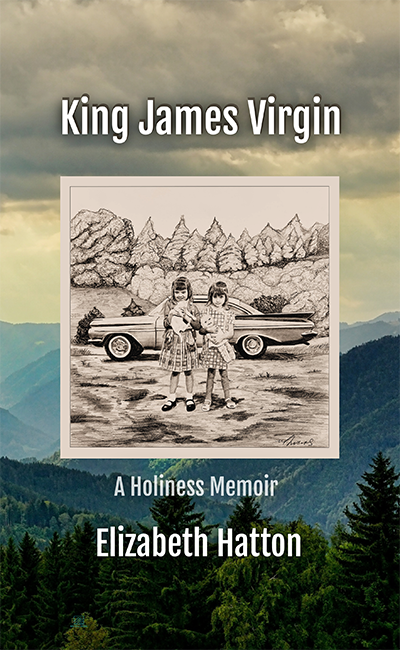 e by Jendi Reiter
"It was late in the fall, right at hog-killing time, when we got the bad news about the president." So begins Elizabeth Hatton's King James Virgin: A Holiness Memoir, a reconstruction of the beliefs and lifeways of her family's Pentecostal Holiness community in rural Kentucky. While the narrative loosely centers on the winter of 1963, when Hatton was in third grade, as its temporal touchstone, her discursive storytelling weaves together anecdotes from multiple generations of her family and their neighbors.
With its arresting first sentence, King James Virgin signals that this won't be your typical Baby Boomer memoir about middle-class disillusionment after the fall of Camelot. Her people don't exalt world leaders or define themselves in reference to them. In a way, their insular and sin-haunted worldview is radically democratic: John F. Kennedy is first and foremost a man like themselves, vulnerable to the dangers of our fallen world.
It was common knowledge that grown men sometimes got themselves shot. Most, if not all, my classmates knew someone who'd either been shot or had shot someone else.
Just weeks earlier, a classmate's daddy was shot down, but he had time to call on Jesus before his lifeblood ran out…His desperate drunken petition gave his heartbroken people hope that Jesus saved him as he had the repentant thief on Calvary. (page 5)
This passage is a perfect example of Hatton's narrative style, free-associating from one memory to another, with the thread being thematic rather than chronological. It reminded me of the way that my friend who was raised in South Carolina tells a story, unhurried and full of subplots.
A cynic might say that the level of drunkenness and violent feuds in this community contradicts the superior holiness they aspire to with their modest dress and abstention from secular media. As I see it, they're aware that they are sinners coping with economic hardship and classist condescension from Christians of other denominations (whom they call "Higher-Ups" in a kind of reverse snobbery). They have a realistic understanding of how people crack under stress.
This was one of the most beautifully written books that we received this year. The style combines the plain-spokenness of a Johnny Cash ballad with cozy sensory details reminiscent of Little House on the Prairie. First-round judge Annie Mydla said, "This author has a talent for pointing out truths that feel surprising while fitting right into what we already know about America."
King James Virgin hewed closely to Hatton's childhood point of view. While it seems likely that Hatton has thought critically about the problematic aspects of her community's mores, this was not explicit in the text. Her story led me to conclude that she developed anxiety and obsessive-compulsive traits as a child because of the church's hellfire teachings, and that her mother suffered from depression because she had to give up her career ambitions to raise a family. The community mistrusted anyone who wasn't "kin" and believed that Christians outside their particular denomination might be damned. I don't expect every memoir about a high-control religious upbringing to end in rejection of its strictures, but I was left wondering if Hatton today perceives the costs of this lifestyle in a way she did not as a child.
In the absence of an adult retrospective voice or an author bio, I also wanted to know more about how someone from a separatist community that mistrusted education (especially for women) had come to write a polished literary work exposing its flaws as well as its virtues. That's a journey that couldn't have been easy or predictable.
Despite these omissions, King James Virgin is a great read to dispel stereotypes and create mutual understanding between different subcultures in America. Move over, Hillbilly Elegy, this is the real deal.
Read an excerpt from King James Virgin (PDF)
Buy this book on Amazon.