


 One Leaf, One Life
Ramiro F. Prudencio
North Street Book Prize 2025 (view all the winners)
Honorable Mention, Art Book
Critiqu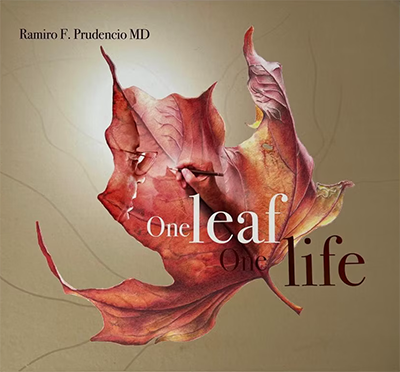 e by Jendi Reiter
Dr. Ramiro F. Prudencio's art book One Leaf, One Life showcases his colored-pencil portraits of fallen autumn leaves, accompanied by lyrical reflections about the themes and memories that their shapes suggest. The book is a handsome hardcover with gold-embossed lettering over a russet maple leaf that seems to be dancing on the wind. (Look closely and you'll see an image of the artist's profile and his drawing hand within the leaf's folds!) The interior features glossy ivory-tinted pages and an easy-to-read serif font, plus luxury touches like full-color endpapers and a transparency over the frontispiece. The whole presentation effectively communicates "inspirational gift book".
The life story that emerges in anecdotes throughout this book is as distinctive as the drawings themselves. Born in Cochabamba, Bolivia, in 1938, he lost an eye from an injury at age five, making his future development as an artist that much more remarkable. As a young doctor, he moved to Chicago to pursue a surgical specialty, eventually becoming the head of the urology department at Saint Francis Hospital in Evanston, IL until his retirement in 1996. His study of Ikebana, the Japanese art of flower arrangement, led him to his second vocation as a botanical illustrator.
Using colored pencils, Prudencio created incredibly detailed close-ups of 50 leaves and one flower (the artichoke), usually choosing subjects advanced in age because their colors and shapes became more expressive in decay. The images are grouped by type of tree—maple, poplar, cottonwood, and so forth—with the scientific name for its genus and species alongside each image. Some of the accompanying essays talk directly about the tree variety or why he chose that leaf, while others free-associate from the leaf's shape to an important memory he wants to share. Two of the illustrations in the book were showcased in a prestigious international botanic exhibit in New York City.
The written reflections would have benefited from editing for more concision and to limit digressions into unrelated subjects. Particularly in the introductory pages, I would have trimmed some of the paragraphs of sentimental abstractions. The short essays about trees' ecology and anatomy, how we perceive color, and the history of fertilizer were instructive. However, weighting the front of book with all this information slowed down the reading experience and puzzled me a little about which genre this book wanted to be in. It might have been better to include condensed versions of these scientific asides as sidebars interspersed with the leaf portraits.
The printed book stood up well to multiple readings and had no obvious errors. One would be hard-pressed to distinguish One Leaf from a coffee-table book by a commercial publisher. Educational and inspiring, Prudencio's work combines a scientist's accuracy with a mystic's soul.
Read an excerpt from One Leaf, One Life (PDF)
Buy this book from the author's website.