
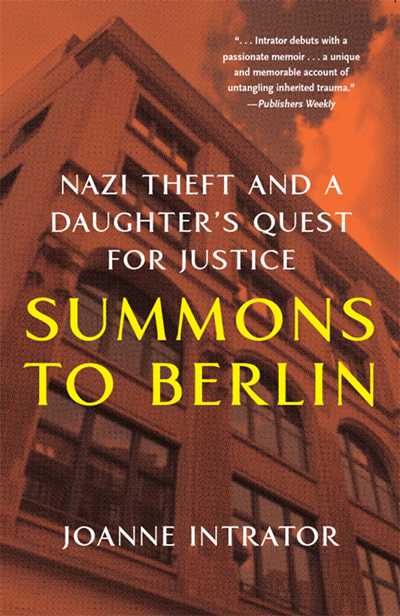
 Summons to Berlin: Nazi Theft and a Daughter’s Quest for Justice
Joanne Intrator
North Street Book Prize 2025 (view all the winners)
Honorable Mention, Creative Nonfiction
 Critique by Jendi Reiter
Dr. Joanne Intrator's memoir, Summons to Berlin: Nazi Theft and a Daughter's Quest for Justice, chronicles her successful nine-year legal battle to win reparations from the German government for a building that the Nazis stole from her father's family. Her training as a psychiatrist specializing in psychopaths' duplicitous use of language primed her to cut through bureaucratic doubletalk.
First-round screener Annie Mydla said: "The author's training in psychology lets her show us the human side to the doubletalk and doublethink of characters not only in the legal system and government, but in her own family history and even in herself, a level of insight around internal contradictions that we as a nation really need as a role model. This is an important story of perseverance in the face of intractable situations."
Originally from Galicia in the Austro-Hungarian Empire (now part of Poland), Intrator's paternal ancestors had lived a prosperous and cosmopolitan life in Berlin for the first decades of the 20th century. Her grandfather founded an import-export business, headquartered at the building on 16 Wallstrasse that would later become the center of the reparations case. Her father was beginning his career in law, and her uncle was a concert violinist. But when Hitler came to power in 1933, the net began to close around the Intrators and their fellow Jews, who were first expelled from their professional careers and then forcibly divested of their assets.
The author's parents escaped to America, but the shadow of the Holocaust reached into her childhood. She was haunted by the stories of her slain relatives. Her mother saw young Joanne as an extension of herself. Disappointments in Joanne were met with belittling and rage. On his deathbed, in 1993, her father charged her with carrying on his unfinished work of seeking restitution for 16 Wallstrasse from the recently reunified German state. History was inescapable.
On the surface, the new German government made all the right noises about wanting to make amends for the past. Indeed, their reparations program is often cited as a model that America should follow for the descendants of enslaved people. However, Intrator discovered that the process was rife with hidden conflicts of interest, stonewalling by officials, and a desire to whitewash history. More than just money, she wanted acknowledgment of the violation—particularly when she found out that the Nazis had used 16 Wallstrasse to manufacture the stigmatizing yellow star badges for Jews!
This memoir stood out for its self-awareness. The author not only re-created past scenes vividly, but also took advantage of the narrative distance that writing affords, applying critical analysis to her own and others' motivations. What makes a memoir most satisfying and significant is that extra level of reflection on one's past self from the vantage point of the present—a layer that's missing from many of our otherwise well-written entries.
Although her style at times was dry, she admitted that she tends to depersonalize in the face of trauma, so it's hard to fault her for that. I would have liked a family tree in the beginning to keep all her ancestors clear in my mind. You can never go wrong including one of those in a book with a large cast of secondary characters.
We see many memoirs and novels in this contest that deal with the Holocaust, World War II, and 20th-century Jewish history. Summons to Berlin rose above that familiar material by illuminating a lesser-known aspect. Tightly focused, with a wealth of technical details and an emotional through-line, this is an important historical document.
Read an excerpt from Summons to Berlin (PDF)
Buy this book on Barnes & Noble and Amazon.