


 Mbegu
Mbegu
Atukunda Rachael Mutabingwa
North Street Book Prize 2025 (view all the winners)
Honorable Mention, Literary Fiction
 Critique by Jendi Reiter
Atukunda Rachael Mutabingwa's Mbegu, the third book in her series about the fictional African island nation of Adavera, dramatizes the conflict between authoritarian religion and direct experience of divine love. The clash, and the hope for its reconciliation, comes to a head with a romance between Zippy Mbegu, the dictator's daughter, and Lucy Nvaleroah, a descendant of the family that historically opposed him. This magical-realist literary novel surrounds its characters with a distinctive and believable world where shamanic possession by your ancestors coexists with contemporary youth culture and technology.
First-round judge Annie Mydla said, "Mutabingwa's style is really special, combining the sensual, solemn, Adavera patois, and Gen Z slang. This mix of registers is what makes the book feel so rich and sensuous to me, and makes the more familiar parts of the classic coming-of-age plot feel fresh." I also thought the various dialects were used very effectively to show the young adults' code-switching between the world of serious family obligations and their more relaxed and genuine interactions with their peers.
In your typical Anglo-American novel where magical elements are added to our recognizable world, there's often an element of shock or secrecy because the baseline cultural assumption of a secular, mechanistic "reality" is challenged by this additional dimension. Mbegu rests on a different foundation. The self is already multiple: not the atomized individual psyche of the Western Enlightenment, but rather a bundle of connections to your lineage and your community. So when the characters are literally inhabited by their dead forebears in order to resolve intergenerational conflicts, they have a shared framework to make sense of the experience.
Nonetheless, they cannot avoid the universal existential clash between fate and free will: am I more than the pattern that my predecessors have laid out for me, and how do I assert that without rupturing my relationship to those I hold most dear?
Mbegu includes a wealth of queer and polyamorous representation in a natural and joyful way. Neither of the competing religions seems to have any problem with sexual diversity. This book challenges stereotypes of Africa as a monolith with respect to LGBTQ tolerance. Certainly, many of the governments are still repressive (not that America in 2026 is in any position to throw stones) but people's actual views are more complex.
This innovative and uplifting book would have benefited from tighter plotting with fewer repetitive elements. It zoomed in primarily on the two young women's love story and family problems, whereas I would have liked some breaks for wide-angle depictions of the political context to raise the stakes earlier. The island was in the middle of an armed conflict with ethnic cleansing carried out by Zippy's father against Lucy's people. All this original world-building yearned for fuller employment.
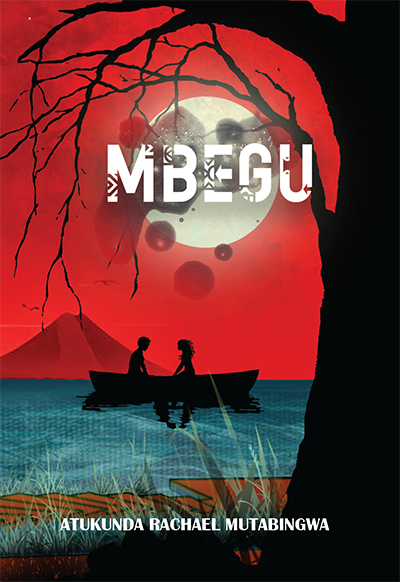
The book cover was a striking shade of red with a black silhouette painting of two young lovers in a rowboat on a dreamy blue lake. The overarching tree branches form a portal inviting the reader into a mystical world. I was less enamoured with the interior design of the printed book. The somewhat informal typeface seemed more suited for an unpublished manuscript than a published book. The margins on the inside edges of the pages were much narrower than those on the outside edges, enough to make reading a little uncomfortable where text curled into the center. The binding showed some creases after reading. (The Kindle edition was spared these problems.)
Mbegu is a unique, ambitious book with a timely theme and a great deal of humor and pleasure in the characters' relationships. We're happy to see Mutabingwa return to the winners' circle with this sequel to her 2020 North Street prizewinner, Kunda.
Read an excerpt from Mbegu (PDF)
Buy this book on Amazon.