



 The Burnable Seas
Jonah Walters
Tom Howard/John H. Reid Fiction & Essay Contest 2026 (view all the winners)
First Prize, Nonfiction
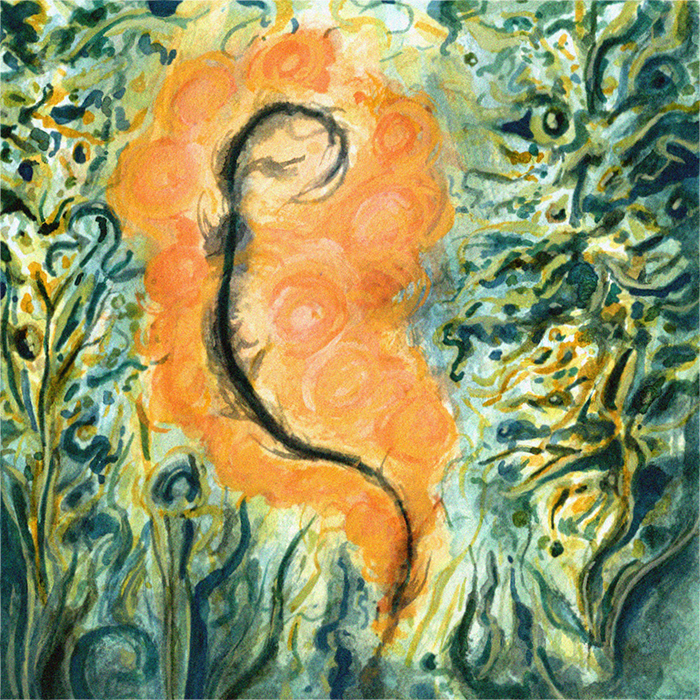
Illustration by Rowan Fridley
The gyrating columns of giant kelp are so tall they can only be compared to redwoods. Translucent bladders shaped like radishes, called pneumatocysts, buoy the biomass to the surface. There the giants splay out, turning their many mottled flippers toward the sun. They cap the meniscus of the ocean in a dense vegetal mat that sways back and forth with the tide.
Churning the water with your feet, you use your arms to push the mats of kelp downwards and away from your face. Each swipe of your trawl-hand exposes a new vista: here a copse of interwoven fronds, beaded with bobbing pneumatocysts; there a mighty grandfather of a stalk, strong and wooly, shimmying in a spray of sun beams.
You kick onwards, carving lazy figure-eights between the kelp trunks. You glimpse a school of blue perch shivering in the understory, and suddenly you know how a falcon must feel when it spies a mischief of rodents on the forest floor: buoyant and nimble. It's good to be in the canopy. You soar. Occasionally you aspirate saltwater through your snorkel.
You're sixty nautical miles off the coast of California, facedown in the great kelp forest.
More specifically, you're at Channel Islands National Park. The Channel Islands are southern California's garter belt. They trace the curve of its bight and press the waters tightly to its shores. Along this string of barrier islands, the admixture of warm and cool ocean currents, paired with a strong upwell of gametes, makes for ideal kelp-growing conditions.
I visited last summer with my family. We woke up early and drove to the dock in soggy Oxnard, an hour up the coast from Los Angeles. The day-tripper was a sturdy, undecorated vessel with a swim-step and a macerating commode. Before we settled on the deck, the captain invited us to return to our vehicles any firearms or cannabis we might have brought aboard his boat. (He waited with his eyes closed for a moment, to spare us the embarrassment.) Then we shoved off towards the kelp.
After about an hour of steady motoring, we sidled up to the nearest of the park islands: Anacapa. We launched our dinghies. I shared a tandem kayak with my mother. Being the more experienced paddler, she took the coxswain position in the rear. Her job was to remind me to heave-ho whenever I became distracted. My job was to pull strings of kelp out of the water with my paddle, so as to better admire their bumps and ridges in the light.
Paddling past Anacapa Island, I learned that dangling one's feet in the ocean water, feeling the soft brush of chilly kelp fronds, was divine. Snorkeling there, I learned how it felt to be weightless, like a shadow. Like a ghost.
*
A few months after my Channel Islands excursion, I woke up early and drove to Santa Monica. I had an appointment at a medical imaging clinic operated by the large university where I work. It's strange to be a patient at your workplace. As I shuttled from room to room, each new doctor confirmed not just my name, but also my departmental affiliation. They were trying to be collegial.
A few weeks earlier, at the big hospital, a doctor had taken a hard swallow, then quickly searched my eyes for signs of weakness. His fingers were pressed against the side of my throat, really digging in, the way a man who went to medical school ought to touch a neck. He said I had a mass in the fleshy canal next to my windpipe. He called it a "cystic lesion." His voice curled into a question mark as he rattled off a list of symptoms—weight loss, fatigue, unusual itching?
I answered no to all of them. But I had lost weight. There's no use arguing with numbers, the doctor said, highlighting the relevant section of my chart. He referred me for an ultrasound and biopsy. He didn't say the scary word at all.
At the imaging clinic in Santa Monica, I watched a stooped woman in baggy jeans shuffle across the waiting room. She leaned hard on the receptionists' desk, hands and shoulders shaking. I overheard the receptionist confirm her date of birth. She was ten years older than me. I would have guessed she was my parents' age.
The technician took me into a chilly room and turned her back while I changed into a hospital gown. She dug the ultrasound wand into my neckflesh. She tut-tutted and sucked her teeth. Finally a doctor came in, accompanied by a troop of interns clutching little notepads like cub reporters. The doctor looked at the screen, then at the technician. Then he turned to me.
There was definitely a cystic lesion, he said. But the ultrasound also turned up an alarming clump of lymph nodes higher in the neck. He showed me the screen: a bouquet of little black radishes, ringed in white, with bright swooshes of arterial blood rushing beneath them. The bastards were pressed against my carotid artery. They could not be biopsied.
The doctor's voice was firm and serious. He referred me for a full-body CT. He said to schedule it soon. Before the end of the week, if possible. Like his colleague at the big hospital, he searched my eyes for signs of weakness. Unlike his colleague, he said the word. The word was lymphoma. The CT was to check for metastasis.
"I know this is a lot to handle," said one of the cub reporters.
"What is? Be explicit."
"The possibility," answered a pair of them in unison. "The chance."
Santa Monica is a salty bead of asphalt bobbing like a pneumatocyst at the terminal edge of Los Angeles sprawl. I left the clinic and walked down Montana Avenue to the cliffside Palisades Park. I looked out at the yellow beach and the blue ocean. I traced the continent's curve northwards with my eyes, following the cars up the famous Pacific Coast Highway. Here was LA's "backyard Big Sur," as the writer Mike Davis called it, before he died of throat cancer. It was nice enough to look ridiculous. Nice enough to piss me off.
Theoretically, on a clear day, one can almost see the eastern tip of Anacapa Island from the beach at Santa Monica. I say theoretically because days like that don't happen in this century. Permanent smog clings to the horizon, mixing with the slurry of evaporating seawater Californians call "marine layer." It makes a rusty stripe that blots out everything past the squid boats that sometimes shoal off Malibu.
I turned my face towards the channel anyway.
In 1602, coming around Anacapa Island, the conquistador Sebastián Vizcaíno noted "much kelp" buffering the shores, with air-bladders "large as gourds" and "tubes like sackbuts." (Sackbuts were brass instruments similar to today's trombones.) "The captain's ship passed over it as if it were a green meadow," his diarist recorded.
In 1769, another conquistador, Vicente Villa, retraced his countryman's earlier route. "The sea was lead-colored," Villa wrote in his captain's log, and there were "many patches of sea-weed," in which floated "a kind of leek, or sea-onion of considerable size, with stems two fathoms in length." He noted the kelp's locations using the archaic "yervazal", meaning grassland.
A few decades later, in 1795, the Scottish botanist Archibald Menzies dove into the same waters from the flagship of the famed Vancouver Expedition. Emerging from the water, Menzies described a forest full of swaying giants, with stems "not much thicker than a man's finger." Each of these was "beset with large leaves undulated on both surfaces" and "mechanically buoyd up by an air bladder." He was impressed by their "very beautifull appearance" on the surface of the sea. Menzies was in awe. I like to imagine him facedown in the canopy, lips wrapped around a snorkeling valve, beard floating like a cloud.
Writing from Big Sur in 1965, the novelist Richard Brautigan described the California coastline as "a million-year-old skid row for abalone and kelp." The abalone are mostly gone now, from what I understand. So is the kelp. And so is Richard Brautigan, who shot himself in 1984, looking out his living room window at the lead-colored sea.
*
At the end of the Ice Age, some 20,000 years ago, the great kelp forest was so long and dense as to clothe the whole Pacific rim. From the Aleutian Islands of Alaska all the way down Patagonia, the vast American landmass was edged by an unbroken stripe of brown-green sea.
The environment was lush beyond belief. Pinnipeds spun and dove in the kelp groves, hunting 300-pound finfish. Countless molluscs held fast to each stipe and frond. The 10-ton Steller's sea cow propelled itself like a gargantuan caterpillar through the overstory, grazing on kelp during the wet months and over-wintering on its own fat reserves when the ocean froze.
Until recently, most anthropologists accepted that the first Americans probably came on foot from the lost continent of Beringia, traveling overland along a land bridge that linked Siberia and Alaska during the waning days of the Ice Age. Called the "ice-free corridor hypothesis," this was the going theory for half a century or more.
But in 2007, a team of Channel Islands archeologists proposed an alternative explanation. They called it the "kelp highway hypothesis".
Their major insight was that the kelp ecosystem was surely a prehistoric migrant's dream. The thick growth would have suppressed near-shore waves enough to provide safe passage for canoes, and rowers could have even tied up their boats at night using kelp stipes. Rather than walking out of Beringia, the first Americans probably greeted the end of the Ice Age by following the great kelp forest down the Pacific coastline.
The Americas were populated not at footspeed, but at the much zippier pace of maritime travel. Skimming the brown-green ribbon in their watercraft, long-distance mariners spread across the American continent from its western edge. Following rivers inland, they covered the hemisphere from tip to terminus in less than a millennium. The kelp brought the people home.
"Seafaring people have been living along the mainland and islands of the Santa Barbara Channel for more than 520 generations," write a group of indigenous Chumash leaders in the 2021 book Islands Through Time. "The island and marine ecosystems co-evolved with our ancestors and our culture."
On the islands and on the mainland, Chumash people harvested kelp to eat and use for medicine. Healers treated swelling using kelp wraps. Dancers performed dances in praise of the kelp, called Shutiwɨyɨish, alongside tributes to swordfish, skunks, and bears.
The Chumash elder Kitsepawit, also called Fernando Librado, described the kelp dance to the anthropologist John P. Harrington in the early 1900s. The dancers "painted their faces with dots of black and white" and imitated "the movements of the seaweed," Harrington wrote, paraphrasing Kitsepawit. "If anybody was sick...it was thought that adding this dance would bring them out of that state of melancholy."
Another elder, María Solares, sang the kelp songs for Harrington's phonograph recorder. You can hear Chumash singers reciting the same songs today, having learned the words and melodies from Solares's wax cylinders. In one song, short phrases pile up relentlessly, like breakers at high tide. In another, long syllables unfurl like cumulonimbus clouds. The whisper and clatter of rattles, perhaps made from pneumatocysts, accompanies both.
*
Kelp has long been prized on the other side of the Pacific Ocean, as well.
Hǎizǎo (海藻) is the preferred term for all seaweeds in Traditional Chinese Medicine (TCM). Curiously, it tends to be rendered in English as "sargassum", a word for the prickly brown algae found in the Atlantic and Indian Oceans. The doppelganger of hǎizǎo is kūnbù (昆布), a loanword from Japanese that tends to refer to flat-flippered seaweeds used in cooking. Hǎidài (海帶), a colloquialism, can be a synonym for both. Or neither. It all depends on context. Like kelp, words are slippery.
No matter the alias, however, brown macroalgae have been used in Chinese botanical medicines for well over a thousand years. A survey of pharmaceutical treatises produced between the Eastern Jin (317–420) and Qing (1616–1911) dynasties documents hundreds of prescriptions calling for hǎizǎo, kūnbù, or a mixture of the two. Kelp was "the agent of choice" for decoctions treating thyroid disease, writes the scholar H.T. Huang, and it was also prescribed for cervical lymphadenopathy—the abnormal growth of lymph nodes in the neck.
That got my attention.
The sun was hot the morning I drove to Chinatown, and I'd overslept, which put me behind the traffic on the 101 freeway. I crawled under the stone towers of downtown Los Angeles and parked near the dragon gate. I had the characters for hǎizǎo, kūnbù, and hǎidài saved in a large format on my cellphone. I felt reasonably prepared.
The first TCM pharmacy I tried turned out to be a famous one. The line snaking down the block was a cross-section of greater Los Angeles. I saw a clump of shy teenagers wearing heavy makeup and toting Labubus. A tired-looking man in a high-visibility vest with a hard hat carabinered to his dusty backpack. A smattering of elderly East Asian women, most of them alone. Besides Chinese and English, I heard Spanish, Russian, Farsi, Tagalog, Portuguese.
Only a few customers were allowed inside the store at a time. This rule was probably meant to accommodate patients' desires for privacy. It also accommodated patients' desires to produce short-form video content for social media.
I watched through the open door as a handsome man with silver dreadlocks took his turn at the counter. He was shadowed by another man holding an iPhone mounted to a ring light. The second man swooped and dove in the manner of a guerrilla videographer as a white-coated pharmacist examined the handsome man's tongue. Meanwhile, the next patient in line walked backwards towards a row of antique-looking cabinets, selfie-stick held aloft, saying "hi guys!" in the universal cadence of Instagram reels.
I set off walking down North Broadway. A few blocks away, at an imported foods store, a cashier led me to the supplements aisle and pressed a pill bottle labelled "Hai Zao Wen—Seaweed Pills" into my hands. Another few blocks, another pharmacy, and this time the pharmacist chuckled when I asked about hǎizǎo. He gestured towards a rack of Japanese snack foods, then turned his back to help another customer.
At last, I came to a storefront guarded by two orange cats. Inside, patients stepped forward one by one to speak with a ponytailed pharmacist who stood smiling behind a thick panel of plexiglass.
When I asked about hǎizǎo, the pharmacist pulled a weathered cardboard box from under a low shelf and invited me to poke around inside. The first layers of the box contained a collection of plastic bags labeled kūnbù and stuffed with translucent brown florets. I kept digging, and at the bottom I found a vacuum-packed palette of hard brown-green ribbons cut into rectangles. A handwritten label displayed the Chinese characters for hǎizǎo and two English words in shaky handwriting: KELP SHEET.
When I got home that night, I tucked the kelp sheet away in my kitchen cupboard. My CT appointment was scheduled for the next day. I don't know much about CT scans, but I do know the technicians inject you with iodine first. Iodine stains your organs blue. It also stains tumors. Somehow this makes the pictures clearer. I didn't want to confuse the machine.
*
Etymologically speaking, kelp is just as slippery in English as it is in Chinese. The word originated in the Scottish Isles in the 1500s, when islanders learned that the wrinkly seaweed washing up on their shores burned down into a highly desirable mixture of chemical salts called "potash".
"Kelp" emerged from these coastal Scottish workshops, with their hot cauldrons and racks of drying seaweed. At first, the word was just a local synonym for potash. It referred only to the ashes, not the algae. The unburnt seaweed was called Alga Marina or, more commonly, "sea-ware".
Upon visiting the Hebrides in 1703, the geographer Martin Martin described fields "Manur'd with Sea-ware," and beef-cattle "fattened by it." Local youths even raced their algae-fed horses atop the bluffs, swinging "a piece of long Sea-ware in each hand, instead of a Whip."
In its unburnt form, the sea-ware was vital to the islanders' subsistence. But in its burnt form—that is, as potash—it could be loaded onto boats and taken to overseas markets, where it always sold for a tidy sum. Scottish lairds seized upon the new commodity, eager to transform ashes into cash. Tenant-farmers were suddenly compelled to work at kelp-burning, leaving their fields unplanted. The spectre of famine floated like smoke above every potash cauldron.
On the Orkney Islands, where kelp was known as "sea-tangle" (or simply "tang"), villagers resisted the new industry through rebellions both big and small. A new horror emerged in the local folklore—a skinless sea-demon called Nuckelavee, who took "terrible offense" at the burning of sea-tangle. When the scent of kelp smoke reached his nostrils, the Nuckelavee would fly into a "diabolical rage", devouring people and livestock alike. (The English ethnologist W. Traill Dennison documented these stories in 1891.)
Some islanders begged their lairds for reprieve, insisting that ''the kelp kilns would...smite with barrenness their sheep, horses, and cattle, and even their own families," recalled the vicar George Barry. But others took matters into their own hands. In 1762, a mob of tenant-farmers marched along the Orkney coast, destroying seaside kilns and casting payloads of potash into the sea. Royal authorities charged the rioters with crimes against the Crown, but local juries refused to convict them. "It is the common opinion of Orkney," said one ringleader to the court, "that the burning of Tang in this country" has sullied crops and sickened livestock, such that "poor people were deprived of that part of their food."
Still, the lairds kept the kelp-pots aflame. Potash was in high demand. It was used in the manufacture of soap and glass, among other things. Most importantly, however, potash was a chemical precursor to saltpeter—the key ingredient in gunpowder. With the Napoleonic Wars in full swing, powder-makers throughout Europe turned to kelp to satisfy their armies' demands for ever more firepower.
It was one such powder-maker, a Frenchman named Bernard Courtois, who in 1811 stumbled upon the sea-ware's secret treasure. Fussing about in his gunpowder workshop, Courtois isolated an unknown liquid that emitted brilliant purple fumes. This was a new element: iodine. Kelp was full of it.
No one gave a second thought to iodine while the wars lasted. On battlefields from Austerlitz to Waterloo, each retort of cannon or blunderbuss announced the sea-ware's purpose. Once the Napoleonic Wars were over, however, European chemists began to appreciate the new element's peculiar powers.
For one thing, it turned out to be a powerful weapon in the war between microbe and man. In 1873, the French pathologist Casimir Davaine discovered that iodine was a voracious destroyer of what he called "le virus charbonneaux"—a highly lethal bacterium known in English as anthrax. Iodine quickly became indispensable to surgery and emergency medicine. Physicians shortly figured out that iodine was also extremely effective for treating thyroid disease, especially the swollen neck condition called "goitre", endemic in the Swiss Alps. (Chinese pharmacists, of course, had already been using seaweed to treat goitre for more than a thousand years.)
Today, iodine's most significant medical use is as a dye, or contrast medium, for CT scans. Organs and blood vessels can absorb iodine harmlessly, and its atoms emit photoelectrons when exposed to X-rays. Injecting a patient with iodine makes it far easier for radiologists to visualize disease, especially cancer.
An estimated 10 million litres of iodine dye are used in CT scans per year.
*
My CT was scheduled for 9:30 pm on a weekday. I passed the time on campus, tucked away in my cubicle. I tried not to be dour as my colleagues went gigglingly into the good night. I was finding it a lot to handle. The possibility. The chance.
The CT machine was a low altar in a clean white room. I lay down and put my arms over my head as the technician anointed me with iodine through an IV. The altar scrolled forward along its tracks. It offered my pelvis to the collimator. Then my chest. Then my neck.
Lying under the gantry's spinning maw, I had the sensation of slipping into the sea.
In the final tablet of the Epic of Gilgamesh, the hero stumbles upon "a matter most secret" under the choppy ocean waters. It is a seaweed "like a box-thorn," with "prickles like a dogrose." Called Plant of Heartbeat and Old Man Grown Young, it promises eternal youth.
Gilgamesh ties stones to his feet and lowers himself into the brown-green depths. He returns to the surface with a cutting of the secret seaweed (probably sargassum, which is plentiful in the Sumerian—now Persian—Gulf). But Gilgamesh turns his back to bathe, and a snake steals his prize away. The snake confirms the seaweed's magic by shedding its old skin and emerging renewed.
Gilgamesh spends the final stanzas of his epic in tears, begging his gods in vain for the seaweed's return. The memoirist Gretel Ehrlich, a Californian, makes something of a reply to Gilgamesh in her 1994 book A Match to the Heart. One day, while walking with her dogs in landlocked Wyoming, Ehrlich suddenly feels that she is "deep in an ocean," with her arms "held out straight, cruciate." She realizes she has fallen, paralyzed, to the ground.
Lying on her back among the rocks and nettles, Ehrlich is overcome by the sensation of death. "Brown kelp lies flat in mud," she writes, as "the continent of the body dissolves." Then comes one thready heartbeat, and then another, until "a whole kelp forest rises from the ocean floor." She swims back to life as if through sunlit water, "surrounded by blue."
Ehrlich had been struck by lightning. But she survived. She recuperated in a house overlooking the Channel Islands, watching the kelp nod its many heads beneath the waves.
*
Kelp is not a species, nor a genus, nor a taxon. It's not a scientific term at all. The word is a floating signifier. Its meaning wobbles as it transits time and space, turning over and flipping around.
Linnean classifications, those antiquey Latin names that scientists invent, are no help to us here. What a Californian calls kelp (Macrocystis) is a thin stem with long fronds. What a Scotsman calls kelp (Laminaria) is a thick stem with a tuft on top. In China, a pharmacist says hǎizǎo and a chef says kūnbù—they both envision a rope made of tangled florets, dark as wood-ear mushrooms and thick as a python's trunk; this is Saccharina, or "sweet kelp". But when a translator ferries these words into English, they hook together and become Sargassum, a brown macroalgae with barbs like holly.
It's hard to appreciate this fact from the wet seat of a kayak, but when you look at a seaweed and call it kelp, what you are naming is its combustibility. Kelp is algae you can bring ashore and burn. This is the only consistent meaning of the word, the only definition as true in twentieth-century California as in sixteenth-century Scotland.
In California, Chinese migrants began clipping small amounts of kelp in the 1800s, exporting their take to East Asian culinary markets alongside abalone. The Chinese Exclusion Act of 1882 squeezed this enterprise to the point of disappearance, and by the turn of the twentieth century, Chinese mariners had been ejected from the California coastal zone. Japanese vessels took over the fishery. Divers wearing fish-bowl helmets walked slowly along the ocean floor, plucking abalone from the rocks and stipes. Each diver was accompanied by a "kelp-cutter," who used long shears to clear a path for the helmet's air hose.
By the 1910s, American munitions companies had clustered on the California coast, forming what the geographer Javier Arbona has called "the Silicon Valley of explosives." When World War I broke out in 1914, these firms squashed the Japanese abalone industry by investing heavily in kelp harvesting and processing. This was not only because Germany sat on some of the world's major reserves of terrestrial potash (export of which, naturally, the country found contrary to its war aims). It was also because kelp turned out to be a fantastic source of a volatile compound called acetone.
Acetone was the key ingredient in a smokeless gunpowder called cordite, which the British needed for their rifles. By breaking down into both potash and acetone, the kelp serviced each of the wartime economy's major chemical demands at once. Even in the twentieth century, the sea-ware still delivered miracles.
The glut of war-profits to be made sent waves of prospectors into the California bight and onto the barrier islands. "Kelp beds are proving veritable gold mines on Santa Cruz Island for a number of young men," reported the Santa Barbara Daily News. "They harvest the kelp from rowboats, dry it on the sands, and set the dry kelp heaps afire." These young men could earn as much as $45 per day selling potash.
The U.S. Department of Agriculture shortly established its own kelp-processing plant in Summerland, a sleepy town near Santa Barbara founded thirty years earlier as a spiritualist commune. The USDA sent two trawlers to clip the kelp around San Miguel and Santa Cruz islands. According to the historian Peter Neushul, who tells the story in a 1989 essay called "Seaweed for War", these trawlers could harvest as much as 50 tons of kelp per hour.
The industry's real juggernaut was a private outfit from Chula Vista. The Hercules Powder Company provided an estimated 30,000 tons of kelp-derived cordite to British quartermasters between 1914 and 1917. At war's end, an official from the Ordnance Department personally delivered appreciation badges to each of the plant's employees, calling their work "a vital part in the prosecution of the war, second only to the part played by the man in actual contact with the enemy."
Four hundred thousand tons of kelp were harvested each year from the California coast while the Great War lasted, according to the state Game and Fish Commission. But the armistice brought the industry to a standstill. There was no need for it anymore.
The great kelp forest slipped below the horizon. Where trawlers once huffed coal-smoke, there was only the lead-colored sea.
*
The CT scan revealed no lymphoma. No signs of metastatic disease in the neck, abdomen, or pelvis. The cyst was still visible, but that alarming bouquet of swellers further up the neck was gone. The CT didn't show it, at least. The first doctor, the one with the strong hands, called to give me the news. I could hear his smile through the phone.
The big sky, the beach sand, the blue ocean. Suddenly everything looked so nice it was silly.
*
No serious observer has ever doubted that kelp is a living thing. But the nature of that life—how does kelp live?—was a puzzle that beguiled naturalists for generations.
It boiled down to a question of sex. Brown algae was known to proliferate with incredible speed and intensity, creating enormous blooms that leapt across vast swaths of ocean in a single season. But where did the new kelp come from? How were its babies made?
The mystery of algal reproduction drove some naturalists to the point of eccentricity. In 1861, the Frenchman Jules Michelet praised kelp for its "marvellous amorousness," waxing poetic about "strange hymeneal metamorphoses" that evinced a lifeforce "beyond being...beyond power." Michelet spent his days gazing at kelp fronds through a microscope lens, waiting for "the consecrated moment" when they would "quit their merely vegetable life and leap into animality."
Around the same time, an amateur naturalist in New York City named Charles Durant was living "a sort of amphibious life," haunting the piers and rock breaks of Brooklyn and Staten Island "in quest of specimen." Durant ultimately convinced himself that the seaweeds he collected were moving, full of purpose and intelligence, under his magnifying glass. Striding happily between the kelp-mats on Rockaway Beach, Durant felt he had solved the mystery. Algae was not a plant, but an animal. He expected this discovery would make him as famous as Linnaeus.
Durant was wrong, of course. Algae is not an animal. Nor is it a plant. It is something altogether more unique.
In 1949, the British phycologist Kathleen Drew-Baker documented the reproductive cycle of nori, a brown algae prized in Japan. It turned out nori reproduces through spores. The algal lifecycle does not proceed in a straight line from origin to growth to death. Instead, algal cells toggle between diploid and haploid phases, achieving life through unending transformation.
In recent decades, pharmacologists working at the intersection of TCM and Western medicine have begun to document kelp's effects on the lymph nodes at a molecular level. As it turns out, brown algae contain a unique class of polymers called sulfated polysaccharides. These are gooey combinations of sulfate enzymes and sugar substrates that occur naturally in algal cell walls, and which are probably responsible for the kelp's distinctive slippery texture.
One of these polymers is called fucoidan. Fucoidan seems to promote the proliferation and speedy migration of lymphocytes. Lymphocytes are a class of white blood cells, including the cancer-killing T- and NK-cells, that are vital for healing. They originate in the marrow and circulate through the lymphatic system, destroying diseased cells along the way.
By interacting with cell adhesion molecules called selectins, fucoidan may lubricate the pathways between lymphocytes and the bodily regions where they're most needed—like, for example, an inflamed lymph node in the neck. A recent study in Japan even suggested that fucoidan may act as a kind of protective sheath around healthy lymphocytes, slowing the progression of human T-lymphotropic virus (HTLV-1), a retrovirus that can develop into aggressive blood cancers.
Curiously, fucoidan from Macrocystis—the "giant kelp" characteristic of central California—seems to work better than fucoidan derived from other brown macroalgae in clinical settings. No one knows why. Its special property is "a matter most secret," as Gilgamesh might say.
*
I'm trying the Chinatown hǎizǎo tonight. I open the pill bottle first. It's full of chalky brown basketballs a little smaller than Advils. Their smell reminds me of fish food: gamey and briney. I put them aside for the morning.
I pull out the kelp sheet. I slit the vacuum-pack open and select two dry ribbons about the length of my forearm. They're coarse and stiff enough to crack. I simmer them in a pot until they soften and puff up, curling into waves. The steam smells salty and vegetal, like wind blowing in from a beach.
The kelp tea is a pale forest green. It tastes grassy, fishy, alkaline.
I don't even think about it. I open my mouth up wide. I drink it all.