

Three Books that Almost Won a North Street Book Prize
The North Street Book Prize is not just about honoring great self-published and hybrid-published books. The contest is a laboratory where we explore and share what makes a great book. We have a special interest in books that almost won a prize. The authors of these three books from our 2025 contest have generously allowed us to present what we loved about their books and what, in the end, held them back.
—Annie Mydla, Managing Editor
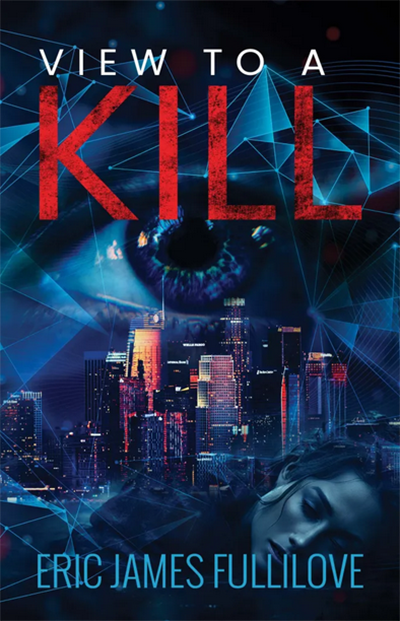 VIEW TO A KILL
Author: Eric James Fullilove
Final rank: Finalist
Contest category: Genre Fiction
You should read this book if:
You like dystopian sci-fi and believe that we need to take action against systemic racism, brutality, and corruption. Black Lives Matter!
Synopsis:
Systemic racism and a plutocratic conspiracy trap Jamal Smith, a Black American man, on death row for the murder of tech billionaire Ellen Pompeii. Telepath Jenny Sixa knows Smith is innocent, but proving it is hard when the truth threatens the investments of the point-oh-one percent. Suspense rises as Smith's execution draws closer and we witness the true scale of the bad guys' advantage. The twist ending and its call to action left me socially outraged and literarily impressed.
Remained a Finalist because:
(Spoilers!) View to a Kill's rising action builds up readers' righteous anger against corruption, structural racism, and brutality, then transforms the anger into a desire to act for social justice. Jamal's execution is one of the catalysts—an Orwellian climax that, like the killing of George Floyd, stokes our outrage over anti-Black brutality in America. However, readers already conditioned to the Race Against the Clock trope might expect that Jamal will be rescued at the last second, then feel an anticlimax at his death instead of the climactic motivation we are meant to feel as our expectations about the corrupt system are proven true. The present structural ambiguity let other competitors nudge ahead. I wonder whether readers could have been told Jamal's fate at the very beginning, ensuring that the tension in the rising action came from dreading the inevitable rather than hoping for a rescue.
Another factor that prevented this book from advancing was the inconsistent use of past- and present-tense narration within scenes. We see this problem often in books where the author intended to use present tense throughout, because one naturally falls into the past-tense voice when conveying backstory or memories. A novel is not a movie. Consider whether present tense is really necessary to convey action-packed immediacy. If you do decide to follow this (in our opinion, overused) trend, ask a human to copyedit your manuscript for inconsistencies that your computer's grammar-checking tools won't catch.
 SEE ME
Rhoda Berlin
Final rank: Finalist
Contest category: Genre Fiction
You should read this book if:
You want to listen in on some really good conversations about being a person of color in America in 2026, what it's like to have intergenerational trauma as the child of Asian-American immigrants, and what multicultural, multiethnic friendships can truly be.
Synopsis:
Korean-American Seattleite and therapist Jackie Kessler investigates the so-called suicide of a former client whose family is suing Jackie for malpractice. Amy Nguyen was a rising indie rockstar with everything to live for. Past therapy with Jackie had put her past the risk of self-harm. Jackie suspects murder, and teams up with former police detective Allan Shaw to prove it. The social awareness of the book is stellar, and it has some of the best dialogue I've ever seen in this contest. The cast of multicultural, multiethnic Seattleites is ideally designed to make these multi-layered, issues-based conversations feel absorbing and personal.
Remained a Finalist because:
(Spoilers!) A crime novel will typically have more suspects than investigators. Surrounded by suspects, the main investigator is alone and at risk, raising the narrative stakes. In contrast, Jackie keeps accumulating fellow investigators and allies, and their conversations make up most of the book, while the number of suspects is much lower. The high reliance on dialogue and lack of action/confrontation reduced tension in the rising action and made us lose sight of the mystery plot.
Counterintuitively, I did find there to be something refreshing in the low tension. It was good to see a novel with a protagonist of color where the interest was not based on their being in danger. The large number of investigator-allies formed a buffer that successfully pushed the stakes away from Jackie's safety and onto the international, intergenerational trauma at the heart of Amy's mystery. That mechanism also put the book in a tricky genre spot, however, because the moment-to-moment reading experience seemed to dilute the murder mystery genre identity rather than harnessing it. I enjoyed the book as written, but we decided to go with submissions that more fully embodied their chosen genre. I would be curious to see a literary fiction version or a version that fully embraces a stricter crime genre format.
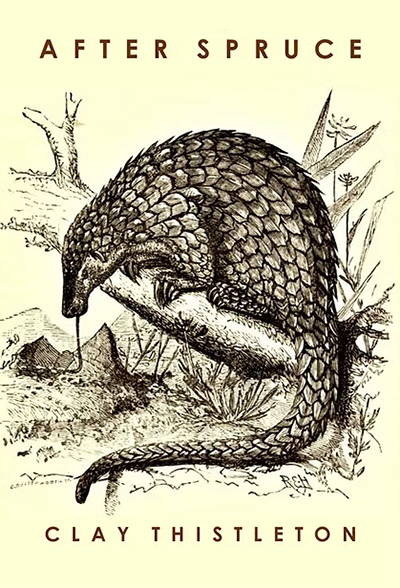 AFTER SPRUCE: POEMS IN THE MANNER OF TOM JENKS' "SPRUCE" DURING THE TIME OF THE CORONAVIRUS PANDEMIC
Clay Thistleton
Final rank: Semi-Finalist
Contest category: Poetry
You should read this collection if:
- You enjoy modern poetry
- A little part of you gloried in the postmodern weirdness of COVID-19, and you don't necessarily know how to feel about that
- You need a booster shot of WTF
Synopsis:
Zap back to the kaleidoscopically jumbled world of elbumps and quaranqueens in this chapbook from the land down under. I thought I'd never forget 2020's nth-degree layers of weird, but After Spruce showed me how much I'd repressed. Line after line brought it back: "contactless delivery for prime ministerial hair plugs" (may actually have happened); "mansplaining The Croods from the national parliament" (did actually happen); "the forty-fifth president and his basket of maggots / anointing the shoulders of the Lord of the Flies / the goats and the elephants dog-whistle the rat lickers" (ongoing!?)
Irreverence is far from the end goal of this collection, and it does give homage to the raw pain: "the seven stages of grieving are subject to stay-at-home orders", "tectonic fault lines fissure with grief", and "howled sobs" are "choked in throats that are numb". But it doesn't let us forget that the most coherent, meaningful images from COVID were indivisible from the crude absurdities, the real-life suffering un-quarantinable from the memes; for months, we drifted in a warp where at any moment we might collide with something like "Nicki Minaj's cousin's friend's testicles" distressingly imposed over "the tired sobbing of nurses in car-park field hospitals".
Other submissions in poetry, fiction, and nonfiction since 2020 have shied away from the shame and awkwardness—eagerly fleeing the lockdown paradox of how powerless we were to curate what we were exposed to. After Spruce achieves a wider and more unexpected range of emotional impacts by holding space for the brutality of the era's juxtapositions.
Remained a Semi-Finalist because:
Specificity can be a double-edged sword in any book destined for public consumption. Too little, and the book overlaps with other books past the point of interest (many entries to the North Street Book Prize are rejected for exactly that reason). Too much, and the potential readership shrinks. After Spruce presents an interesting mix: its pandemic content is widely relatable, while its poetic source is more specialized. The specificity of the poetic model undoubtedly had a positive impact on the collection's competitiveness compared to other COVID-themed collections we've received in the past.
On the other hand, without the context of the original Spruce, a general readership may not be fully prepared to appreciate After Spruce. That let more self-contained competitors slip ahead. Our final judge also felt that the poems' list-like form was too lacking in variation, causing the surreally juxtaposed cultural references to lose impact after a while because they were not embedded in any larger narrative or lyric with a personal emotional perspective. I liked the collection on its own, but found that reading both collections let me recognize points of departure in Thistleton's, especially with tone, that deepened my experience. Tom Jenks' Spruce is available for order through his website.
Categories: Advice for Writers, Annie in the Middle